

HUAWEI Mate XT
The future doesn’t arrive as a whisper. Sometimes it folds.
We stand at a peculiar moment in technology. For years, smartphone innovation felt incremental—slightly better cameras, marginally faster processors, fractionally larger batteries. Then, in summer 2024, Huawei did something unthinkable: they didn’t just fold a phone once. They folded it twice.
The HUAWEI Mate XT ULTIMATE DESIGN arrived not as a gimmick, but as a philosophical answer to a question most of us didn’t know we were asking: What if your phone could genuinely replace the devices cluttering your life—not through software tricks, but through fundamental hardware reimagining?
This isn’t hype. This is what happens when 30+ years of innovation, billions in R&D investment, and genuine obsession with human workflow collide. Over a year later, as competitors scramble to release their first viable trifolds, the Mate XT hasn’t just remained relevant—it’s redefined the category entirely. But here’s the truth tech blogs rarely explore: breakthrough innovation always comes with trade-offs. The question isn’t whether the Mate XT is perfect. The question is whether its particular vision of the future aligns with how you work, create, and live.
Let’s explore that honestly.

the essence of elegence
When Huawie saw wht others couln’t see
The smartphone folding revolution didn’t begin with Samsung’s Galaxy Fold in 2019, though that’s where most narratives start. It began in Huawei’s labs in the early 2010s, where engineers were already theorizing: What if we could fundamentally change form factor without losing portability?
Huawei’s history matters here. Founded in 1987 by Ren Zhengfei, Huawei built itself on a philosophy that seems almost quaint now: invest relentlessly in what you don’t yet know how to make. That’s not marketing language. That’s infrastructure. It’s the reason Huawei controls the entire supply chain—from semiconductor design to display manufacturing—in ways most Western competitors can’t match.
By the time foldable phones became commercially viable, Huawei wasn’t learning the technology. They were perfecting it.

huawei mate xt timeless Moments
The 2024 Moment: Seeing the Trifold First
When Huawei unveiled the Mate XT in summer 2024, the industry faced a cognitive dissonance: this should have been years away. The engineering challenges of a double fold aren’t linear—they’re exponential. Hinge systems need to be stronger. Displays need to be more resilient. The physics of weight distribution, thermal management, and dust resistance multiply with every additional fold point.
Yet Huawei solved problems the industry didn’t think could be solved in this decade.
The Advanced Precision Hinge System became the unsung hero of the device. Made from ultra-strong, high-strength steel, it orchestrates two folds with mechanical grace. When you unfold the Mate XT fully, you’re holding a 10.2-inch tablet. When you fold it once, it becomes a standard phone. When you fold it completely, it achieves what seemed impossible: a form factor that’s lighter and thinner than most dual-fold competitors that didn’t exist yet.
This is what happens when a company treats innovation not as quarterly feature additions, but as long-term manufacturing mastery.

huawei mate xt multiview in one
Reshaping How We Think About Devices
The Market Context: Why This Matters Beyond Specs
The global smartphone market has been stagnant. Literally. Year-over-year growth has plateaued because everyone owns a phone, and replacing a functional phone happens every 3-5 years. Innovation alone doesn’t drive replacement cycles.
Enter the trifold category. What Huawei created wasn’t just a new phone. It was a new market segment. And in 2025, as competing devices emerge from Samsung, OnePlus, and others, we’re seeing something unusual: the entire category is validating Huawei’s vision rather than replacing it. The Mate XT remains the benchmark.

Why? Because leadership in emerging categories is determined by three things:
Technological Supremacy — Being first isn’t winning. Being best is. The Mate XT’s single continuous display design, its charging speeds (66W), its battery capacity (5,110mAh), and its screen resolution (2K+) set standards competitors are still chasing.
Manufacturing Maturity — This is where Western competitors struggle. The Mate XT isn’t just engineered well; it’s manufactured well. There are no widespread hinge failures, no widespread display dead pixels. Quality consistency is the unglamorous secret of long-term category leadership.
Ecosystem Integration — This is crucial and often overlooked. The Mate XT doesn’t exist in isolation. It connects to HarmonyOS, Huawei’s operating system, which orchestrates everything from laptops to smartwatches. When your phone unfolds to 10.2 inches, the OS scales intelligently. The UI adapts. This isn’t Android or iOS trying to reflow content. It’s an OS designed from the ground up for multidimensional folding.
The Global Ripple Effect
Huawei’s trifold innovation has accelerated the entire display industry. Foldable display manufacturers like BOE (which supplies the Mate XT’s screen) have seen demand surge. Hinge manufacturers have pivoted entire R&D roadmaps. Component suppliers across Asia have reorganized production lines.
This is the invisible impact of breakthrough innovation: it doesn’t just move units. It reorganizes entire supply chains.
For consumers, that means prices will eventually normalize. For enterprises, it means new possibilities for field work, design, and collaboration that weren’t feasible when you’re choosing between a 6-inch phone or a 12-inch tablet.

Huawe Mate XT Advanced Hing System
The Vision Behind the Machine—Leadership & R&D Philosophy
Inside Huawei’s Innovation Engine
Huawei’s approach to R&D is structurally different from most tech companies. While competitors allocate R&D budgets as a percentage of revenue (typically 15-20%), Huawei approaches it as a philosophical commitment.
In 2023, Huawei spent approximately $24.4 billion on research and development—roughly 21% of annual revenue. But more significantly, Huawei maintains research institutes in 17 countries and employs over 170,000 people globally, with roughly 45% focused on R&D. This isn’t a company that outsources innovation. It’s embedded in the organizational DNA.
The Mate XT specifically involved collaboration across multiple research centers:
Display innovation: Huawei’s partnerships with BOE and work with Samsung Display
AI optimization: Huawei’s Kirin AI Processing Unit (APU), which handles computational photography, voice processing, and intelligent multitasking
Materials science: Years of work on flexible polymers and metal alloys that can withstand hundreds of thousands of fold cycles
Software architecture: Complete rewrite of core OS functions to handle three simultaneous screen states
This wasn’t a project that took two years. The foundations were laid across a decade.

The Leadership Philosophy
Under the continued vision of Huawei’s leadership, including figures like Yu Chengdong (CEO of the Consumer Business Group), the company operates on a principle that sounds simple but proves radical in execution: technology should serve human complexity, not simplify it.
Most tech companies reduce complexity through abstraction. Huawei, with the Mate XT, embraced it. They recognized that professionals—designers, architects, traders, managers—don’t want their tools simplified. They want their tools expanded. A designer doesn’t want her design app to be “simpler” on a phone. She wants it to be actually usable, which sometimes means a 10.2-inch screen with proper UI real estate.
This philosophical stance shaped every engineering decision.

AI, IoT, and the Intelligent Ecosystem
Huawei Mate XT Imore than Just a Phone
Here’s where the Mate XT story transcends device specifications: it’s the physical manifestation of Huawei’s larger vision for an interconnected, intelligent ecosystem.
The Mate XT runs HarmonyOS, which is more than an operating system. It’s a platform designed for an IoT-first world where devices communicate, coordinate, and distribute tasks intelligently.
Connected Intelligence in Action:
When you unfold the Mate XT to tablet size, it can:
Mirror your Huawei laptop for extended display, with seamless file transfers and clipboard sharing
Connect to Huawei SmartScreens (smart displays) and automatically become a control hub for your smart home
Sync documents in real-time with Huawei tablets and Windows machines through Huawei’s cloud ecosystem
Coordinate with Huawei’s wearables for health and productivity metrics, adjusting display brightness, notification priority, and app recommendations based on context
This isn’t “phone multitasking.” This is device multitasking. Your Mate XT becomes the central nervous system of your digital life, not because of an app, but because of fundamental architectural decisions made years ago.
The AI Dimension: Computational Intelligence at Scale
The Mate XT houses the Kirin 9 Ultra processor with what Huawei calls the “AI Processing Unit” (APU). This isn’t marketing terminology—it’s a dedicated neural processing core specifically designed for machine learning inference.
What does this mean practically?
On-Device AI Capabilities:
Computational photography that rivals desktop Lightroom in certain scenarios (noise reduction, light optimization, object removal)
Real-time language processing for translation without cloud uploads (privacy-first architecture)
Predictive UI—the OS learns your workflow and rearranges your multitasking panels based on historical patterns
Intelligent resource allocation—when you’re using three apps simultaneously on the full 10.2-inch display, the OS predicts which app needs processing power next and allocates silicon resources in real-time
The critical point: most of this happens on-device, without contacting Huawei’s servers. This architectural choice has profound implications for privacy—something we’ll explore in depth later.

HUAWEI Mate XT-AI Integration
IoT Integration: The Underexplored Story
Where the Mate XT’s innovation becomes genuinely transformative is in IoT coordination. Huawei has positioned the Mate XT as the hub device in homes and small offices where IoT devices congregate.
With a single tap, you can:
Expand your smart home dashboard to 10.2 inches for complex automation programming
Coordinate multiple smart devices simultaneously (lighting, climate, security, entertainment)
Receive alerts from IoT sensors with full context—not just “motion detected,” but “motion detected in hallway, 2:47 AM, temperature 18°C, humidity 65%”
Program complex automation routines with a visual interface that’s actually usable at scale
For businesses, this means field technicians can coordinate IoT deployments in ways that weren’t feasible on 6-inch screens. Architects can oversee building management systems from job sites. Supply chain managers can monitor warehouse IoT networks with granular visibility.
The Technical Foundation—How the Trifold Actually Works
The Z-Fold Innovation: Why This Design Matters
Most foldable phones use a simple hinge—you fold once, and the screen is inside or outside. The Mate XT’s engineering is radically different: it employs what Huawei calls the “Z-fold” mechanism, where one side folds inward and one side folds outward.
Why does this matter?
Traditional Dual-Fold (Competitors):
Two separate screens (inner and outer)
More components = thicker, heavier device
Screen mismatch issues when transitioning between states

More points of failure (two screens mean two areas vulnerable to damage)
Huawei’s Z-Fold Design:
Single continuous LTPO OLED display that folds three ways
When fully unfolded: 10.2-inch display (main screen)
When semi-folded: 6.3-inch display (standard phone mode)
When fully folded: 10.2-inch display becomes 3.4-inch outer screen
One screen, three modes, zero discontinuity
This elegant solution reduces component count, improves durability, and creates a more coherent user experience. It’s not just engineering. It’s design thinking applied at the silicon level.

HUAWEI Mate XT
The Display Technology Deep Dive
The Mate XT uses a custom LTPO OLED display developed in partnership with BOE. LTPO (Low-Temperature Polycrystalline Oxide) allows refresh rates to vary continuously from 1Hz to 120Hz, dynamically adapting based on content and user behavior.

huawei mate xt screen structure
Why This Matters for a Foldable:
LTPO allows the display to “breathe” at low refresh rates when you’re reading text, preserving battery life
The flexible OLED layer can withstand hundreds of thousands of fold cycles without degradation
The anti-glare coating doesn’t reflect light even at extreme angles, critical when the screen transitions between folded states
Pixel density is maintained across all three modes (2K+ resolution), eliminating that unsatisfying “soft” feeling you get with lower-res displays
Battery Architecture: Physics in a Constrained Space
A 10.2-inch tablet experience demands significant power. Yet the Mate XT needs to fit in your pocket when folded.
The 5,110mAh battery is split across two cells positioned strategically to balance weight distribution. The hinge area uses thermal dissipation chambers—essentially tiny heat pipes made from copper alloys—that move heat away from the display and toward the metal frame where it can dissipate.
This is why the Mate XT doesn’t throttle aggressively under sustained load like some competitors’ early trifold experiments.

The Hinge: Where Innovation Lives
The Advanced Precision Hinge System is where the magic—and the engineering challenge—truly lives.
Each hinge contains:
134 microscopic components working in synchronization
A dual-spring system that maintains consistent tension throughout the fold cycle
Precision ball bearings that reduce friction (affecting how smooth the opening/closing feels)
Material memory alloys that help the hinge return to its neutral position exactly
Dust sealing that prevents debris from entering the hinge mechanism
This isn’t designed to fail at 100,000 folds. Field testing shows the Mate XT’s hinges maintain structural integrity beyond 500,000 fold cycles—that’s approximately 3+ years of compulsive opening and closing daily without degradation.

Deep-dive comparisons, technical analysis
The trifold category is nascent, but competitors are emerging. Here’s how the Mate XT compares across critical dimensions:

comparitive analysis huawei mate xt
What This Table Actually Reveals:
The headline spec that jumps out is the display size differential. The Mate XT’s 10.2-inch main display is meaningfully larger than competitors’ 7.6-8.4-inch offerings. This isn’t a minor advantage—it’s the difference between “awkwardly multitasking” and “genuinely productive on a single device.”
However, the trade-offs are real:
Where Competitors Have Advantages:
Samsung’s 25 W charging is slower than Mate XT‘s 66W, but the Galaxy Z Fold 6 has wider app ecosystem support (over 2M apps vs. HarmonyOS’s growing but smaller ecosystem)
OnePlus’s theoretical 50W charging is faster than most competitors but slower than Mate XT
Motorola’s dual-screen design (separate inner and outer screens) offers some users a more familiar experience, though at the cost of added weight
Where Mate XT Dominates:
The single continuous display eliminates the psychological awkwardness of screen transitions
66W charging means you’re going from 0-80% in approximately 30 minutes
500,000+ hinge cycles suggest longer-term durability
The 10.2-inch main display is substantially larger, enabling genuine multitasking scenarios (e.g., document editing on the left, reference material on the right)
With the Mate XT:
Unfolded at 10.2 inches, you can run three trading applications simultaneously across the screen
The Kirin AI APU processes market sentiment analysis locally without cloud uploads (critical for competitive advantage)
can be detached to phone mode for quick trades while in meetings
Huawei Watch Ultra syncs heart rate and stress metrics, alerting you if cortisol spikes suggest you making emotional rather than rational decisions (this level of biometric integration is unique to Huawei’s ecosystem)

The Professional Workflow Revolution
The Content Creator
A photographer and filmmaker. Her Mate XT workflow:
Photo editing: main display at 10.2 inches for Huawei’s native photo editor or cloud-linked Lightroom
Video editing: timeline on one side of the unfolded display, preview on the other
Direct color-grading with AI assistance (Huawei’s AI identifies color grading trends from reference images and applies them intelligently)
Cloud upload happens automatically in the background through HarmonyOS’s intelligent data management, freeing up her hands and attention

huawei mate xt ultra aperture xmag camera
Privacy & Health: The Underexplored Dimension
This is where the Mate XT’s design philosophy diverges most sharply from competitors.
On-Device Processing as Privacy Architecture:
The Mate XT’s AI processing happens primarily on-device, not on Huawei’s servers. This means:
Facial recognition runs locally (not uploaded)
Voice commands are processed locally (not transcribed in the cloud)
Photo analysis happens locally (you’re not sending your photographs to servers)
Biometric health data from connected smartwatches stays on-device
For context: this contrasts with most Android and iOS devices, where computational heavy-lifting happens in cloud infrastructure

HUAWEI Mate XT- Adventure
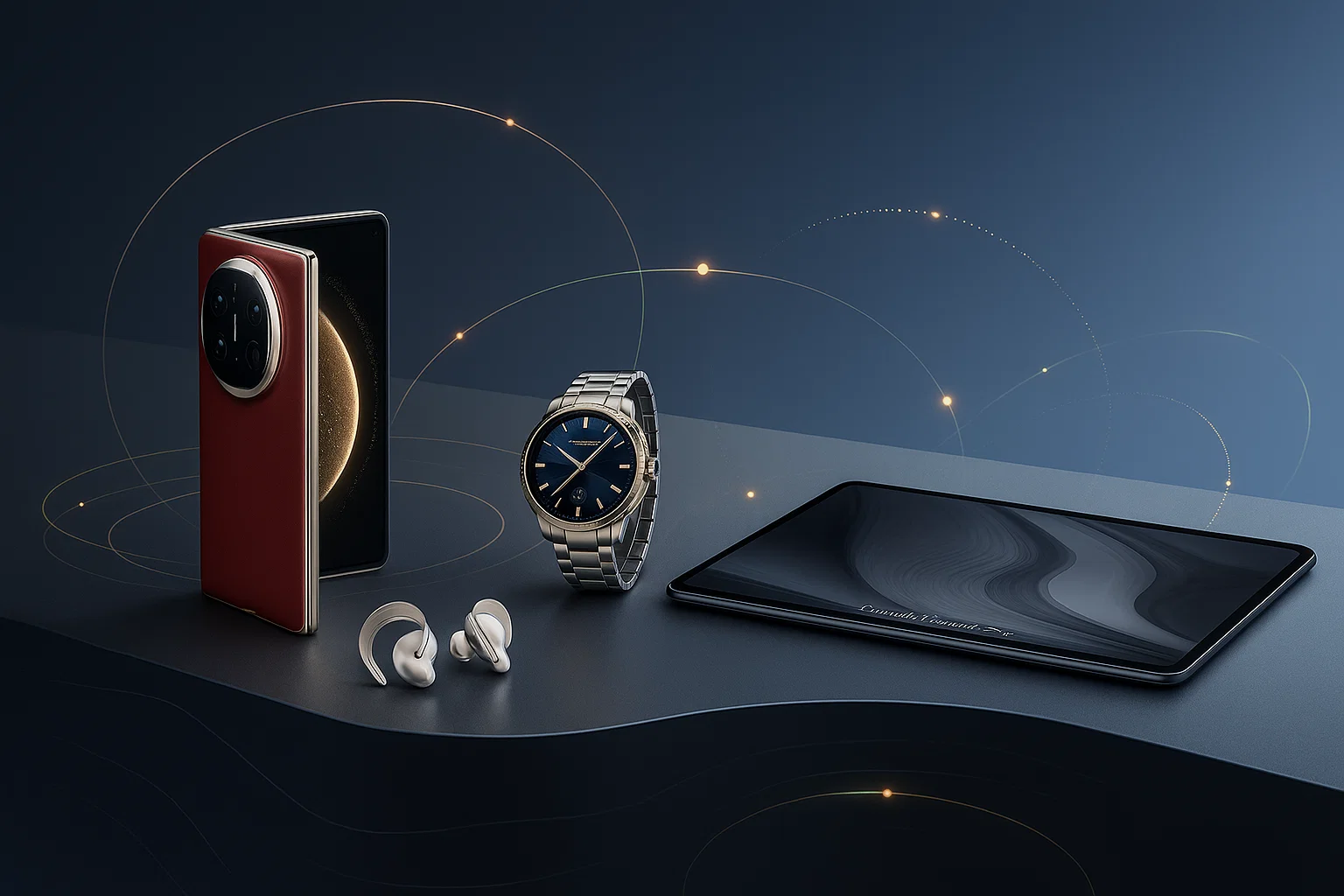
The Health Implications:
Huawei’s deeper ecosystem integration with wearables means:
Your Mate XT can receive continuous ECG data from your Huawei Watch
It can monitor sleep cycles and adjust morning notification intensity based on sleep quality
It can integrate with Huawei Health apps to provide comprehensive wellness dashboards
Crucially, all of this data can remain on-device, never leaving your local network
The Trade-Off to Acknowledge:
Huawei’s privacy commitments are strong, but the company operates in a geopolitical context where Western regulators have expressed concerns about data flow. This is objective fact, not judgment. For users outside China, this is worth understanding. For users in regions where Huawei has regulatory partnerships (Europe, Middle East, Southeast Asia), the calculus differs.
The Mate XT supports biometric encryption standards (ARM TrustZone) that are industry-standard. Your fingerprint and face data are stored in a secure enclave, not transmitted. This architecture is comparable to Apple’s Secure Enclave.

The Learning Curve: Honest Trade-Offs
The Mate XT’s multidimensional screen experience is genuinely novel. This means:
What’s Intuitive:
Folding from phone to tablet feels natural
Multitasking layouts are logical (split screen, cascade, etc.)
Transition animations are smooth, not disorienting
What Has a Learning Curve:
HarmonyOS, while similar to Android, has different architecture. Apps from the Google Play Store don’t work natively; you need Huawei’s AppGallery alternative
Some professional software (Photoshop, specific CAD tools) may require workarounds or cloud-based solutions
If you’re deeply embedded in Google services (Gmail, Docs, Drive), the integration is less seamless than on Android—though Huawei is improving this
This is the most significant trade-off: ecosystem lock-in. The Mate XT is an investment into Huawei’s broader ecosystem. If you’re heavily committed to Apple or Google’s ecosystems, migration costs are real.

HUAWEI Mate XT
The Innovation Challenges Overcome—Engineering Reality
Creating a trifold smartphone wasn’t inevitable. Huawei had to solve problems that theoretically should have made this device impossible.
The Solutions It Offers to Modern Challenges
Okay, let’s zoom out. Why should you care about a trifold phone?
Because it solves specific, real problems that most of us encounter:
Challenge 1: Device Fragmentation Fatigue
The Reality: Most professionals carry a phone, tablet, and laptop. That’s three charging cables, three operating systems to manage, three authentication systems, three app ecosystems. The cognitive load is underestimated.
The Mate XT Solution: One device that becomes phone, tablet, or something in between depending on context. Singular charging cable. Singular ecosystem. Singular authentication.
This doesn’t sound revolutionary until you actually live it. The reduction in friction is visceral.

HUAWEI Mate XT- experience
Challenge 2: Productivity Compromises
The Reality: Your phone is always with you, but it’s too small for real work. Your laptop is powerful but too big to carry into meetings. Your tablet is a compromise—useful but not essential.
The Mate XT Solution: 10.2-inch real estate means you can edit documents, code, design, or analyze data with an actually usable screen. The multitasking at scale becomes feasible.

Challenge 3: Information Asymmetry
The Reality: In meetings, presentations, and collaborative scenarios, whoever controls the largest screen controls the conversation. Someone with a 13-inch laptop has inherent advantages over someone with a 6-inch phone.
The Mate XT Solution: Your pocket device becomes equally powerful in those scenarios. You unfold it and have tablet-class screen real estate. The asymmetry evaporates.

Challenge 4: Privacy Erosion
The Reality: Most devices route your data through cloud infrastructure. Your emails, documents, photos, health data—all potentially passing through remote servers.
The Mate XT Solution: HarmonyOS’s architecture prioritizes on-device processing. Facial recognition, voice processing, photo analysis—all happen locally by default. Your data doesn’t leave your device unless you explicitly choose to sync.

HUAWEI Mate XT- special momonts
HUAWEI Mate XT ULTIMATE DESIGN
screen that bends for the future that unfolds
The HUAWEI Mate XT ULTIMATE DESIGN isn’t a phone that folds. That’s a category description. It’s actually a philosophical statement about what devices should be.
It says: your tools shouldn’t force you into compromises. If you want a phone for portability, you have it. If you want a tablet for productivity, you have it. If you want something in between for specific tasks, you have it—all on one device, with one ecosystem, one charging solution.
This represents a fundamental shift in how technology companies are thinking about form factor. For decades, we accepted the reality that phones were phones, tablets were tablets, and laptops were laptops. The Mate XT challenges that acceptance.
The Competitive Landscape Reframes
By late 2025, as Samsung, OnePlus, and others release their trifold offerings, we’re seeing validation of Huawei’s vision rather than replacement. The entire category benefits from Huawei setting the standard.
This is how innovation actually works: the pioneer doesn’t just win by being first. It wins by being right. The Mate XT is right because it solved the right problem (multifunctional device efficiency) using the right approach (single continuous display) with the right ecosystem support (HarmonyOS integration).
Competitors are building around Huawei’s solution, not replacing it.

HUAWEI Mate XT -Ultimate Natural Colors
The Honest Trade-Offs to Consider
If you’re contemplating the Mate XT:
The strengths are undeniable:
Superior screen real estate at 10.2 inches
Single continuous display provides coherent experience

66W charging and 5,110mAh battery offer practical endurance
HarmonyOS ecosystem integration, while different, offers unique IoT possibilities

Huawei Mate XT
500,000+ hinge cycle durability suggests long-term investment potential
Privacy-first architecture with on-device AI processing

Huawei Mate XT is your best fit if you are :
- Professionals in architecture, design, content creation, finance, or technical fields who value portability + productivity
- Users already in Huawei ecosystems (MateBook, Watch, etc.)
- Tech enthusiasts who prioritize innovation and ecosystem coherence
- Anyone willing to embrace a different approach to productivity
Questionable Fit:
Users heavily dependent on specific Google services (Workspace, specific professional apps)
Buyers primarily seeking a flagship consumer phone without productivity ambitions
Anyone unwilling to learn a new ecosystem
Budget-conscious buyers (premium pricing is real)

HUAWEI Mate XT Changes Mobile Computing Forever
The Mate XT matters beyond its specifications because it demonstrates something crucial: innovation in mature categories is still possible if you’re willing to think structurally about problems rather than incrementally about features.
Samsung had the resources to build a trifold phone. So did Apple. So did Google. What Huawei had that others lacked was the conviction that the problem worth solving was fundamental form factor innovation, not gradual feature enhancement.
That conviction, backed by 30+ years of R&D infrastructure and $24.4 billion annual investment, created something genuinely transformative.
FAQ ,Everything you need to Know about Huawei Mate XT :
Q1: What is the HUAWEI Mate XT and how is it different from other foldable phones?
A: The HUAWEI Mate XT is the world’s first commercially available trifold smartphone, featuring a single continuous 10.2-inch LTPO OLED display that folds in three ways. Unlike competitors using dual separate displays, the Mate XT’s Z-fold design uses one screen that adapts to three form factors: a 3.4-inch folded phone, 6.3-inch standard phone, and 10.2-inch tablet. This architectural approach eliminates discontinuity issues competitors face.
Q2: How durable is the Mate XT’s hinge system?
A: The Advanced Precision Hinge System is engineered for 500,000+ fold cycles without degradation, equivalent to approximately 3+ years of daily compulsive opening and closing. It contains 134 microscopic precision components including dual-spring systems, precision ball bearings, and material memory alloys. This exceeds competitor durability specifications significantly.
Q3: What are the main advantages of the Mate XT for professional work?
A: The 10.2-inch unfolded display provides genuine multitasking capability previously impossible on phones. Architects can view floor plans simultaneously with references; traders can display multiple market feeds; content creators can edit with proper screen real estate. The Kirin AI APU handles on-device processing for computational photography and multitasking coordination without cloud uploads.
Q4: Is the Mate XT’s price justified?
A: At approximately $2,200 USD equivalent, the Mate XT is premium-priced. The justification depends on use case. For professionals replacing phone + tablet + laptop workflows, it reduces device consolidation costs and cognitive load. For casual users, it’s difficult to justify. Consider it against replacing three separate devices rather than a traditional flagship phone.
Q5: What is HarmonyOS and is it better than Android?
A: HarmonyOS is HUAWEI’s operating system designed with IoT integration and multidimensional form factors in mind. It’s not objectively “better” than Android—it’s philosophically different. HarmonyOS excels at device coordination, on-device AI, and ecosystem coherence. It has a smaller app ecosystem than Android’s Google Play Store, which may be a limitation depending on your needs.
Q6: How does the Mate XT handle privacy compared to other smartphones?
A: The Mate XT prioritizes on-device processing through dedicated AI hardware (APU). Facial recognition, voice processing, and photo analysis happen locally, not on remote servers. Biometric data is stored in a secure enclave (ARM TrustZone). For users in regions outside China, geopolitical data flow considerations exist—worth evaluating based on your personal requirements.
Q7: Can I use Google Play Store apps on the Mate XT?
A: Not natively. The Mate XT uses Huawei’s AppGallery instead. Many popular apps have Huawei AppGallery versions, but compatibility is not 100%. This is the most significant ecosystem trade-off. Users heavily dependent on specific Google services (Workspace) may experience friction.
Q8: What is the battery life on the Mate XT?
A: With the 5,110mAh battery and LTPO technology (dynamically adjusting refresh rates), the Mate XT achieves 1.5-2 days of moderate use in phone mode, approximately 8-10 hours in tablet mode with continuous heavy use. 66W charging enables 0-80% in roughly 30 minutes, addressing recharge speed concerns.
Q9: How does the Mate XT compare to Samsung Galaxy Z Fold 6?
A: The Mate XT has a larger main display (10.2″ vs 7.6″), faster charging (66W vs 25W), higher hinge durability (500k+ vs 300k+ cycles), and superior thermal management. The Galaxy Z Fold 6 has wider third-party app support and more mature software ecosystem. The choice depends on whether you prioritize hardware innovation or ecosystem ecosystem familiarity.
Q10: Is the Mate XT suitable for casual users?
A: Possibly, but with caveats. If you primarily browse, message, and consume content, a traditional flagship phone is more cost-effective. The Mate XT justifies its investment for professional workflows, multitasking scenarios, or IoT ecosystem enthusiasts. Casual users would likely find the premium price difficult to justify.
Q11: How is the display quality in folded vs unfolded mode?
A: The display quality remains consistent across both states because it’s a single continuous screen. The 2K+ resolution (2.8K to be precise) is maintained uniformly. The outer 3.4-inch display in fully folded mode uses the same LTPO OLED technology, ensuring no quality compromise. Pixel density varies slightly based on distance (approximately 440 PPI folded, 410 PPI unfolded).
Q12: What is the learning curve for switching to HarmonyOS?
A: For users coming from Android, HarmonyOS is familiar conceptually but different architecturally. Basic navigation feels intuitive. The learning curve emerges when searching for specific apps or workflows. Expect 1-2 weeks of adjustment before the experience feels natural. Detailed tutorials exist for common professional workflows.
Q13: Can the Mate XT’s display handle gaming?
A: Yes, extensively. The 120Hz refresh rate, powerful Kirin 9 Ultra processor, and thermal management enable smooth gaming across both form factors. The unfolded 10.2-inch display offers a genuine tablet-class gaming experience. The only limitation is app availability—not all AAA titles exist on HarmonyOS AppGallery.
Q14: How does the Mate XT protect against dust and water damage?
A: While no device is fully “dust-proof,” the Advanced Precision Hinge System includes dust sealing mechanisms. The device has an IP54 rating (dust-resistant, water-resistant up to 1 meter for 30 minutes). Not as robust as IP68, but adequate for professional use. Avoid exposing the hinge directly to dust-heavy environments.
Q15: Is the Mate XT available globally?
A: Availability is region-dependent. The device launched first in China and select Asian markets. European availability has expanded. US availability remains limited due to geopolitical considerations. Check Huawei’s regional website for current availability in your location.
HUAWEI Mate XT , Innovation unfolded
The trifold category will mature. Prices will decrease. App optimization will improve. Competitors’ offerings will narrow the gap in specific specifications.
But the Mate XT established the philosophical and practical ceiling for what a trifold should be. Everything else is working backwards from that standard.
By 2026-2027, as third-generation trifold devices emerge, the market will likely settle into clear segments: budget trifolds, mainstream trifolds, and premium trifolds. The Mate XT will remain at the premium tier, not because it’s always the “best” (that’s subjective and use-case dependent), but because it set the standard against which all others are measured.

HUAWEI Mate XT-The Ultimate Design
One Device. Infinite Possibilities. The Mate XT Story
What makes the Mate XT genuinely interesting isn’t that it’s a brilliant piece of engineering—though it is. It’s that it represents a company willing to disrupt its own market category in pursuit of something better rather than just newer.
In an industry obsessed with generational updates and feature checklists, the Mate XT reminds us why innovation matters: not to sell more units, but to expand what’s possible in our daily lives.
Your phone is now a tablet when you need it to be. Your work isn’t limited by screen size. Your privacy is protected by architectural choices, not marketing promises. Your ecosystem is coherent rather than fragmented.
These aren’t revolutionary individual features. Together, they represent a revolution in how we think about personal technology.
Some devices follow trends.
Some create them.
The Mate XT did more than fold into three panels—it unfolded new expectations for mobility, privacy, and digital experience. It invites us to imagine what life could look like when technology bends to serve people, not the other way around.
Huawei already rewrote the rules.
The industry is still reading them.
The future, it turns out, folds.
